OEM vs ODM: Which Model Is Right for Your Clothing Brand?
OEM vs ODM, OEM manufacturing, ODM clothing, clothing manufacturing models, how to choose a clothing manufacturer, private label manufacturing
July 7, 2026
OEM vs ODM, OEM manufacturing, ODM clothing, clothing manufacturing models, how to choose a clothing manufacturer, private label manufacturing
July 7, 2026
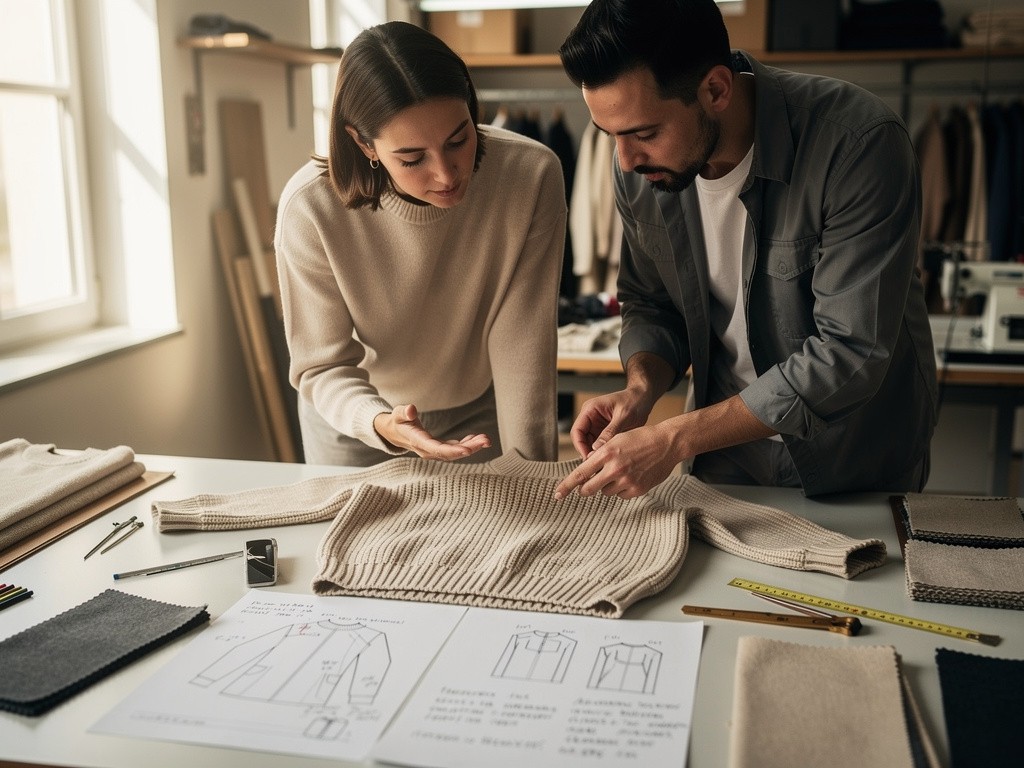
For every clothing brand, choosing the right manufacturing partnership can be just as important as the design itself. You've probably come across the terms OEM and ODM—but what do they actually mean, and how do you know which one fits your brand? These two models represent fundamentally different ways of working, from who owns the design to how much you invest and how much risk you carry. This guide breaks down the difference between OEM and ODM so you can make a smarter production decision for your brand.
OEM stands for Original Equipment Manufacturer. In this model, the brand provides the complete design, specifications, tech pack, and often the chosen materials, while the factory produces the garment exactly to those requirements.
Put simply: the design belongs to you, and the factory brings it to life.
OEM gives brands the greatest degree of control. You decide the fit, the yarn, the colors, the details, and every quality standard—and the factory applies its production capability and capacity to realize your vision. The finished product is entirely your own exclusive design, and no other brand on the market will carry the same piece.
ODM stands for Original Design Manufacturer. In this model, the factory already has ready-made designs or product styles, and the brand can customize them to a certain degree—changing colors, adding a logo, adjusting trims or packaging—before selling under its own label.
Put simply: the design comes from the factory, and you brand it as your own.
ODM allows brands to reach the market faster and with a lower barrier to entry, because much of the research, development, and prototyping has already been done by the factory. For brands that want to launch quickly without starting a design from scratch, it's an efficient path.
| Comparison | OEM | ODM |
| Design source | Provided by the brand | Provided by the factory |
| Customization freedom | High (fully custom) | Medium (modify existing styles) |
| Speed to market | Slower (full development) | Faster (styles ready) |
| Upfront cost | Higher (design + sampling) | Lower |
| Product uniqueness | Exclusive, not replicable | May resemble other brands |
| Best suited for | Brands with a clear design and budget | Brands prioritizing speed and flexibility |
· You already have a clear design vision and a developed tech pack.
· You want to create a unique, non-replicable product and build a strong brand moat.
· You value complete control over quality, materials, and details.
· You have the budget and time to invest in upfront development and sampling.
If differentiation and long-term brand identity are your core competitive advantage, OEM is usually the more rewarding choice.
· You want to launch quickly and capture seasonal trends or market windows.
· Your design resources or development budget are limited.
· You're testing a new category and want to validate the market at lower risk.
· You prioritize efficiency and flexible minimums over absolute exclusivity.
For startups, fast-scaling e-commerce sellers, or brands looking to test a new line at low cost, ODM is a practical and efficient path.
Absolutely. Many growing brands adopt a hybrid strategy: using ODM to quickly launch basics or supplementary lines to maintain a steady flow of new arrivals, while using OEM to create the signature or flagship pieces that define the brand's identity. A factory with both OEM and ODM capabilities can flexibly adjust the way it works as your brand grows—an important factor when choosing a manufacturing partner.
Which costs more, OEM or ODM?
OEM typically requires a higher upfront investment, since you carry the design development and sampling costs, while ODM has a lower entry barrier thanks to ready-made styles. In terms of long-term brand value, however, the exclusivity of OEM often delivers greater returns.
Could an ODM product look like another brand's?
Possibly. Because ODM builds on the factory's existing designs, other brands may use similar styles. You can differentiate to some degree by customizing colors, trims, logos, and packaging.
Which should a startup brand choose first?
With limited budget and design resources, many startups begin with ODM to launch quickly and validate the market, then gradually shift toward OEM to build exclusive products as they grow.
Can one factory handle both OEM and ODM?
Yes. A full-process knitwear factory like VSCOO can produce OEM to your own designs and also offer customizable ODM solutions, helping brands choose flexibly at different stages.
Whether you lean toward the full control of OEM or the efficiency and flexibility of ODM, your success ultimately depends on the manufacturing partner you choose. A factory that understands your brand positioning, communicates transparently, and maintains consistent quality control can deliver excellent results under either model—and grow alongside your brand.
Expert Custom Knitwear Manufacturer
MOQ 100 pcs/style. Response within 24 hours.
Get a Free Quote